


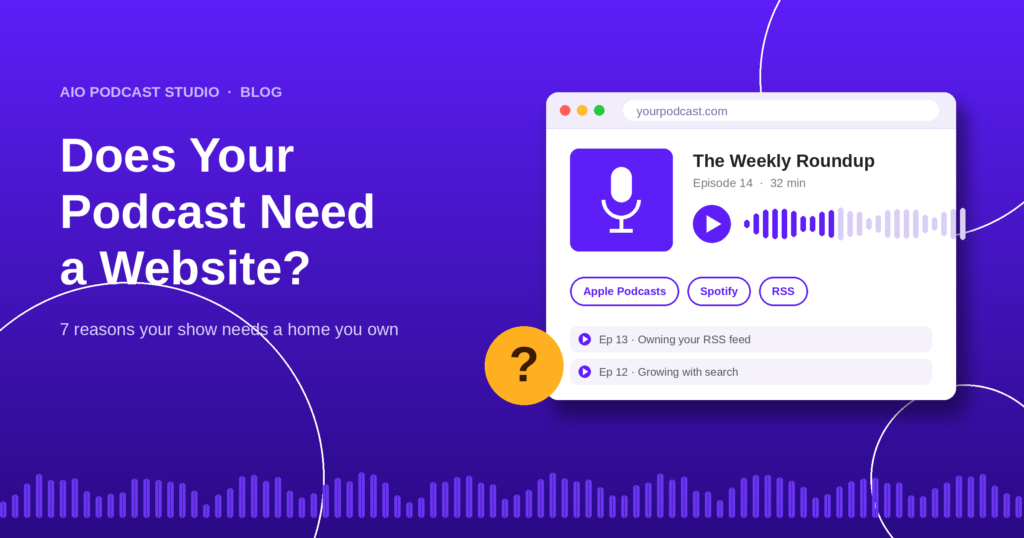

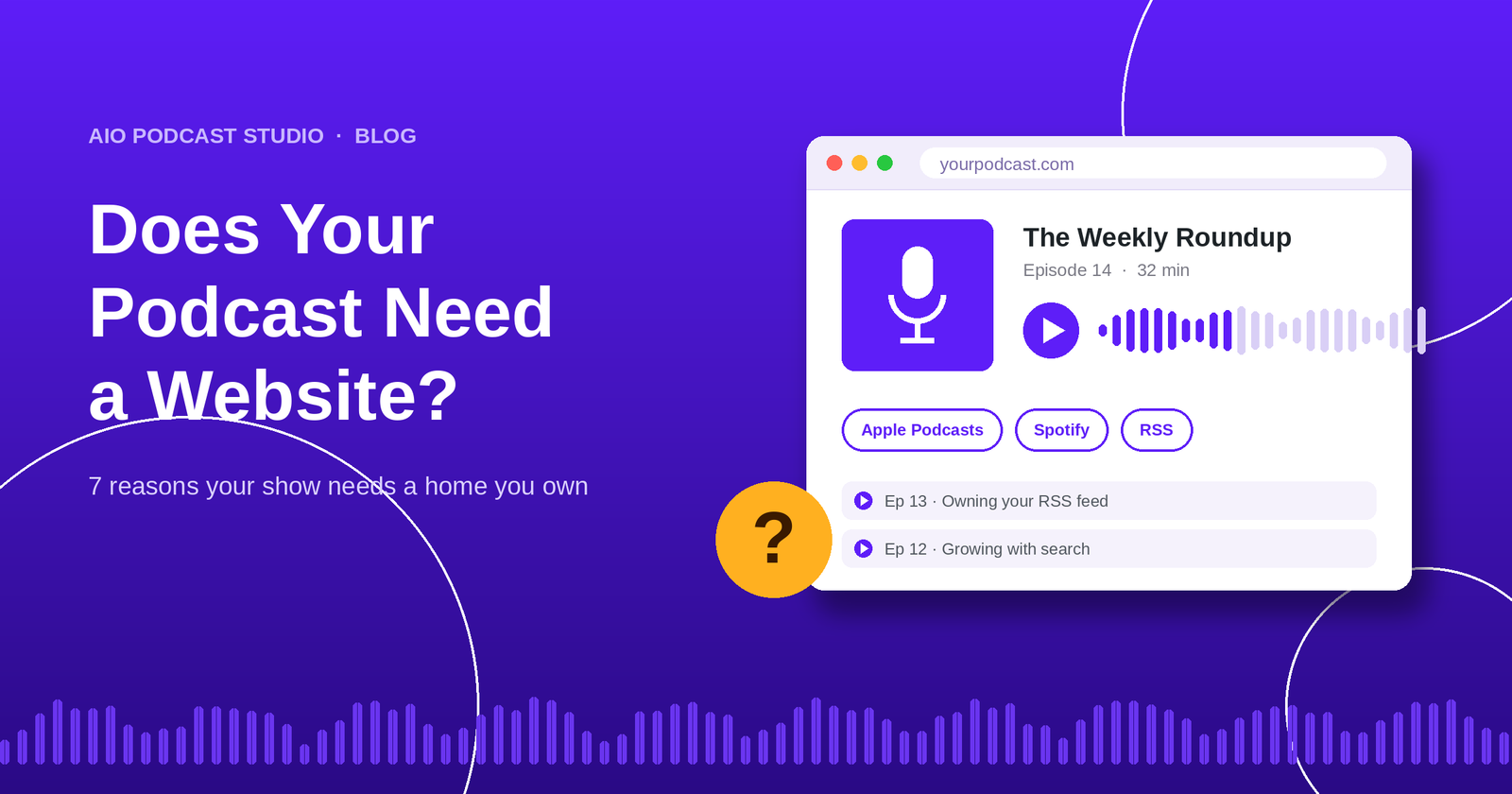
Your podcast is live on Apple Podcasts. It’s on Spotify. Listeners can find it on YouTube Music, Pocket Casts, and a dozen other apps. So here’s a fair question: do your Podcast need a website too?
The short answer is yes—and not just as a nice-to-have. A website is one of the few podcasting assets you fully own, and it quietly does work that no directory or listening app will ever do for you.
Let’s break down exactly why, when it matters most, and the easiest way to set one up.
Directories Are Rented Space. A Website Is Owned Space.
Apple Podcasts and Spotify are essential for distribution, but think about what they actually give you: a listing. You don’t control the layout, you can’t collect email addresses, you can’t see who your listeners are, and you certainly can’t sell anything there.
More importantly, you’re building on borrowed ground. Platforms change their algorithms, their policies, and sometimes they disappear entirely—taking your presence with them. Podcasters who relied solely on Google Podcasts learned this the hard way when it shut down.
A website flips that equation. Your domain, your content, your audience data, your rules. Whatever happens to any single platform, your podcast’s home base stays standing.
7 Reasons Your Podcast Need a Website
1. Podcasts Aren’t Searchable. Websites Are.
Search engines can’t listen to audio. When someone Googles a topic you covered brilliantly in episode 14, your episode won’t appear—unless there’s a written page for it.
Episode pages with show notes, transcripts, and clean metadata turn every episode into searchable, indexable content. Over time, that becomes a steady stream of new listeners who found you through search rather than luck.
2. One Link That Works for Everyone
“Find us wherever you get your podcasts” is a weak call to action. Some listeners use Apple, some use Spotify, some don’t use a podcast app at all.
A website gives you one simple URL to put on business cards, social bios, email signatures, and video descriptions. Visitors land on a page with a built-in player and subscribe buttons for every major platform—no guessing required.
3. A Direct Line to Your Audience
Podcast platforms won’t tell you who your listeners are, and they definitely won’t let you contact them. Your website can.
With a simple email signup form, you can announce new episodes, share bonus content, and stay connected with your audience even if every podcast app vanished tomorrow. For most shows, the email list eventually becomes their most valuable asset.
4. Monetization Beyond Ad Reads
Sponsorship spots are just one way to earn from a podcast. A website opens the rest:
- Affiliate links in show notes
- Merchandise and digital products
- Premium or members-only content
- Coaching, consulting, or service pages
- A media kit page for potential sponsors
None of this is possible inside a podcast directory.
5. Credibility With Sponsors and Guests
When a potential sponsor or high-profile guest checks out your show, where do they look first? They Google it. A professional website with your episodes, audience info, and contact details signals that your podcast is a serious project, not a hobby experiment—and that difference shows up in the deals and guests you land.
6. A Better Experience for Listeners
Show notes with clickable links. Full transcripts for accessibility. Episode chapters. Guest profiles. Related episodes by category or tag. These are the details that turn casual listeners into loyal fans, and a website is the only place you can offer all of them together.
7. Full Control Over Your RSS Feed
Your RSS feed is your podcast’s lifeline—it’s what every directory reads. When your feed lives on your own website, you’re never locked into a hosting company. No exported archives, no redirect fees, no migration panic if a provider raises prices or shuts down.
When Is a Website Not Necessary?
To be fair: if you’re testing a private show for a small team, or running a short-term project with no growth goals, a dedicated website may be overkill.
But if you plan to grow an audience, attract sponsors, or podcast for more than a few months, the question isn’t really whether you need a website—it’s how soon you set one up. The earlier it exists, the sooner search engines start working for you.
What a Good Podcast Website Includes
You don’t need anything complicated. A strong podcast website has:
- A homepage with your latest episodes and a built-in player
- Individual episode pages with show notes and transcripts
- Subscribe buttons for Apple Podcasts, Spotify, and other platforms
- An about page and a contact page
- An email signup form
- Your own podcast RSS feed
That’s it. Everything else is a bonus.
The Easy Way: WordPress + AiO Podcast Studio
Here’s the good news—you don’t need a developer, a separate hosting subscription, or a patchwork of services to get all of the above.
If you have a WordPress website (or are ready to create one), AiO Podcast Studio turns it into a complete podcast platform:
- Publish episodes directly from your WordPress dashboard, with titles, descriptions, artwork, transcripts, chapters, and participants
- Generate a standards-compliant RSS feed that’s ready to submit to Apple Podcasts, Spotify, and other directories
- Display your show beautifully with a modern podcast player and grid, list, playlist, or carousel layouts
- Self-host your media so you stay in full control of your content
- Import an existing podcast in minutes using your current RSS feed
In other words, your website doesn’t just promote your podcast—it becomes your podcast’s home, feed, and player all at once.
Already have a show hosted elsewhere? The import feature brings over your episodes, artwork, and metadata automatically, so there’s no starting from scratch.
Getting Started
- Install AiO Podcast Studio from the WordPress plugin directory (it’s free)
- Create your podcast or import your existing show via RSS
- Publish your episodes with show notes and artwork
- Submit your new RSS feed to Apple Podcasts and other directories
- Add the player and subscribe buttons to your pages using Gutenberg blocks or shortcodes
From zero to a fully functional podcast website—without leaving WordPress.
The Bottom Line
Podcast directories help people find your show. A website helps you own your show—the audience relationship, the search traffic, the monetization, and the feed itself.
If your podcast matters to you beyond this month, give it a home you control.
Happy Podcasting! 🎙️